



The real estate sector remains confident about its prospects, but the cost of finance is becoming an increasingly important factor in investment decisions. New Moore Global research explores how changing capital costs are affecting developers and investors and influencing the allocation of capital across the real estate market.
This article is an abridged and adapted version of the original Moore Global publication.
The cost of finance remains a key challenge
Research conducted by the Centre for Economics and Business Research (Cebr) for Moore Global shows that 33% of real estate companies identify higher interest rates as their number one concern.
Two-thirds of businesses surveyed reported higher costs over the past year, while almost 70% expect costs to continue increasing. The main sources of pressure are interest rates and financing, alongside rising raw material and energy costs.
For the real estate and construction sector, the cost and availability of capital are particularly important. Changes in financing conditions can determine whether a project goes ahead, whether an investor can refinance it and, ultimately, how much an asset is worth.
At the same time, the sector remains more confident about the future than many other areas of the global economy. The main exception is the cost of finance.
Capital allocation becomes more selective
The Urban Land Institute’s global outlook also points to a recovery in liquidity and transaction volumes across major real estate markets.
However, investors are becoming more selective in their capital allocation. With financing becoming more expensive, they are placing greater emphasis on the underlying economics of projects and the durability of demand.
Capital is increasingly flowing into areas such as data centres, logistics real estate, infrastructure-linked real estate, student accommodation, senior living and selected residential markets.
Private credit is also expanding. Debt funds, institutional investors, family offices and specialist lenders are becoming additional sources of capital. However, this type of financing often comes at a higher cost and with tighter conditions.
As a result, while real estate may have more sources of capital than it did a decade ago, securing finance for projects is becoming more challenging.
Thrive Index: the sector remains upbeat
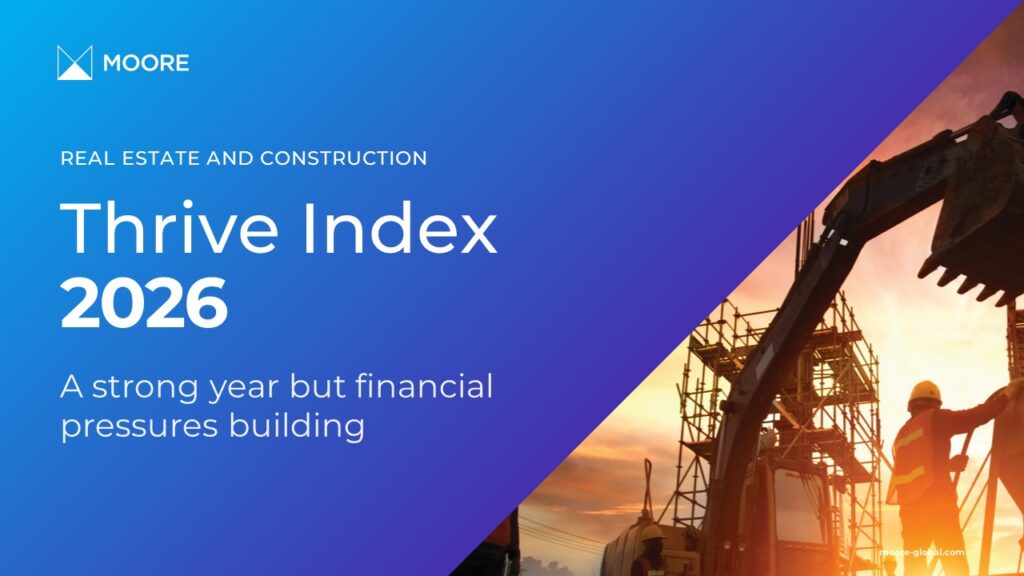
Moore Global’s Thrive Index measures sentiment among 2,400 mid-market companies across more than 30 countries and sectors. It assesses five key areas: general business sentiment, revenue, costs, the labour market and investment.
The latest global Thrive Index score remained at +35.1, while real estate and construction recorded a score above the global average, at +38.2.
Meanwhile, 62% of companies plan to increase their investment spending compared with last year.
The research shows that the real estate sector remains confident about its future. However, the cost and availability of finance are becoming increasingly important factors shaping investment decisions.
Read the original article on the Moore Global website: https://www.moore-global.com/intelligence/real-estates-reckoning-with-the-cost-of-capital/
Moore Intelligence provides up-to-date insights from leaders addressing the key challenges of modern business. To learn more, visit Moore Intelligence.